In professional lighting design, understanding the difference between lumen and lux is essential. Although both units describe light performance, lumen defines luminous flux emitted by a source, while lux measures illuminance on a surface. Confusing lumen vs lux can result in incorrect specifications, oversized installations, and inefficient energy use.
A clear distinction between emitted luminous flux and installed illuminance is essential for accurate lighting design.
Lumen: Luminous Flux at Different Levels
Lumen (lm) quantifies luminous flux. It is the total amount of visible light emitted by a source.
However, lumen values require contextual interpretation. In professional practice, three levels must be distinguished:
Light source lumen output
The raw luminous flux of the LED package or lamp, measured under controlled laboratory conditions.
System lumen output
The actual luminous flux emitted by the complete luminaire, taking into account optical losses, reflector efficiency, thermal management and driver performance.
Installed luminous flux contribution
The portion of system output that effectively contributes to surface illumination within the spatial context.
Historically, fluorescent luminaires such as TCL fixtures frequently achieved 5000lm or more. These lamps emitted light almost 360°, resulting in substantial internal absorption and uncontrolled distribution. A high lumen rating did not necessarily translate into effective task illumination.
Therefore, luminous flux alone does not define lighting performance.
Lux: Illuminance on the Target Surface
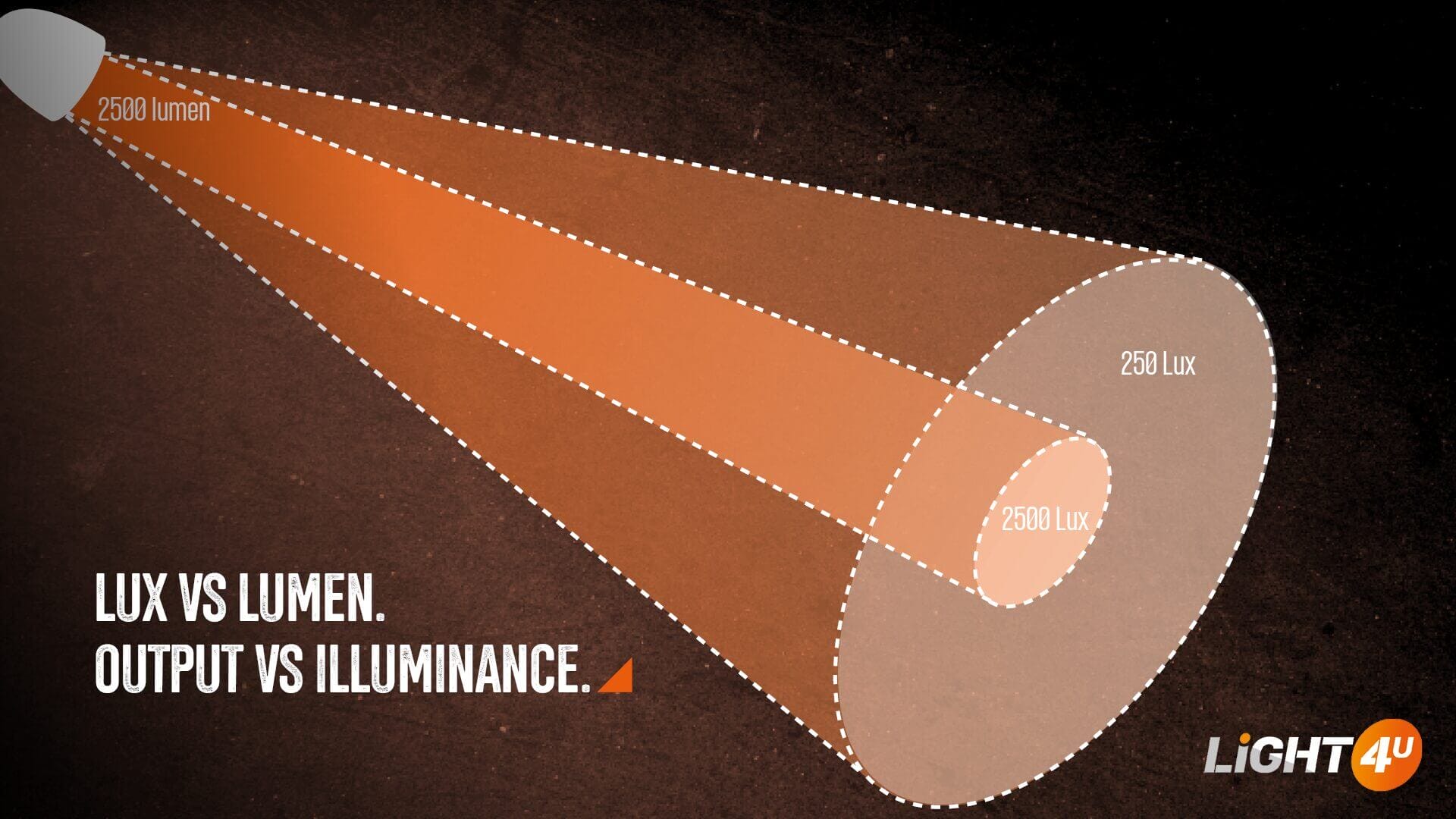
Lux (lx) measures illuminance. It is the luminous flux incident on a surface.
1 lux corresponds to 1 lumen per square metre.
Lux defines the lighting condition experienced within the space. It is the reference metric used in lighting standards and project specifications.
Typical reference values include:
- Office task areas: approximately 500lx
- Retail general lighting: 300–500lx
- Accent lighting: 800lx and above
Illuminance depends on:
- Luminous intensity distribution
- Beam angle and optical control
- Mounting height and distance
- Spatial geometry
- Surface reflectance
Two luminaires with identical system lumen output can produce significantly different lux levels depending on optical design and installation parameters.
From Emission to Application Performance
Directional LED luminaires utilise controlled optics to guide luminous flux toward defined target areas. Reflectors and lens systems concentrate light where required rather than distributing it uniformly in all directions.
As a consequence, lower total lumen output may achieve equal or higher illuminance compared to legacy omnidirectional light sources.
Performance is therefore determined not by maximum flux, but by the efficiency with which luminous flux is converted into usable illuminance within the installed environment.
Determining Lux in Practice
Accurate assessment of illuminance requires photometric calculation during the planning phase.
Professional lighting software such as DIALux or Relux enables simulation of lux levels by integrating room dimensions, mounting geometry, reflectance factors and photometric distribution data.
The critical input for these calculations is the LDT photometric file of the luminaire. This file contains the measured luminous intensity distribution and system lumen output, ensuring reliable simulation results.
For verification after installation, illuminance can be measured using a calibrated lux meter positioned on the relevant working plane.
At Light4U BV, each luminaire page provides the corresponding LDT file, enabling precise photometric calculation prior to specification and installation. Lighting performance should not be assumed based on lumen values alone. It must be calculated and validated.
Conclusion
Lumen defines emitted luminous flux.
Lux defines installed illuminance.
Light source data describes potential.
System output defines capability.
Installed lux confirms performance.
In professional lighting practice, illuminance remains the decisive parameter for evaluating whether a lighting solution fulfils its functional and architectural intent.