When specifying luminaires, colour temperature and CRI are usually clearly defined. However, these parameters alone do not guarantee that fixtures will look identical once installed. Two 3000K luminaires can still appear slightly different in tone.
This is where MacAdam steps become critical.
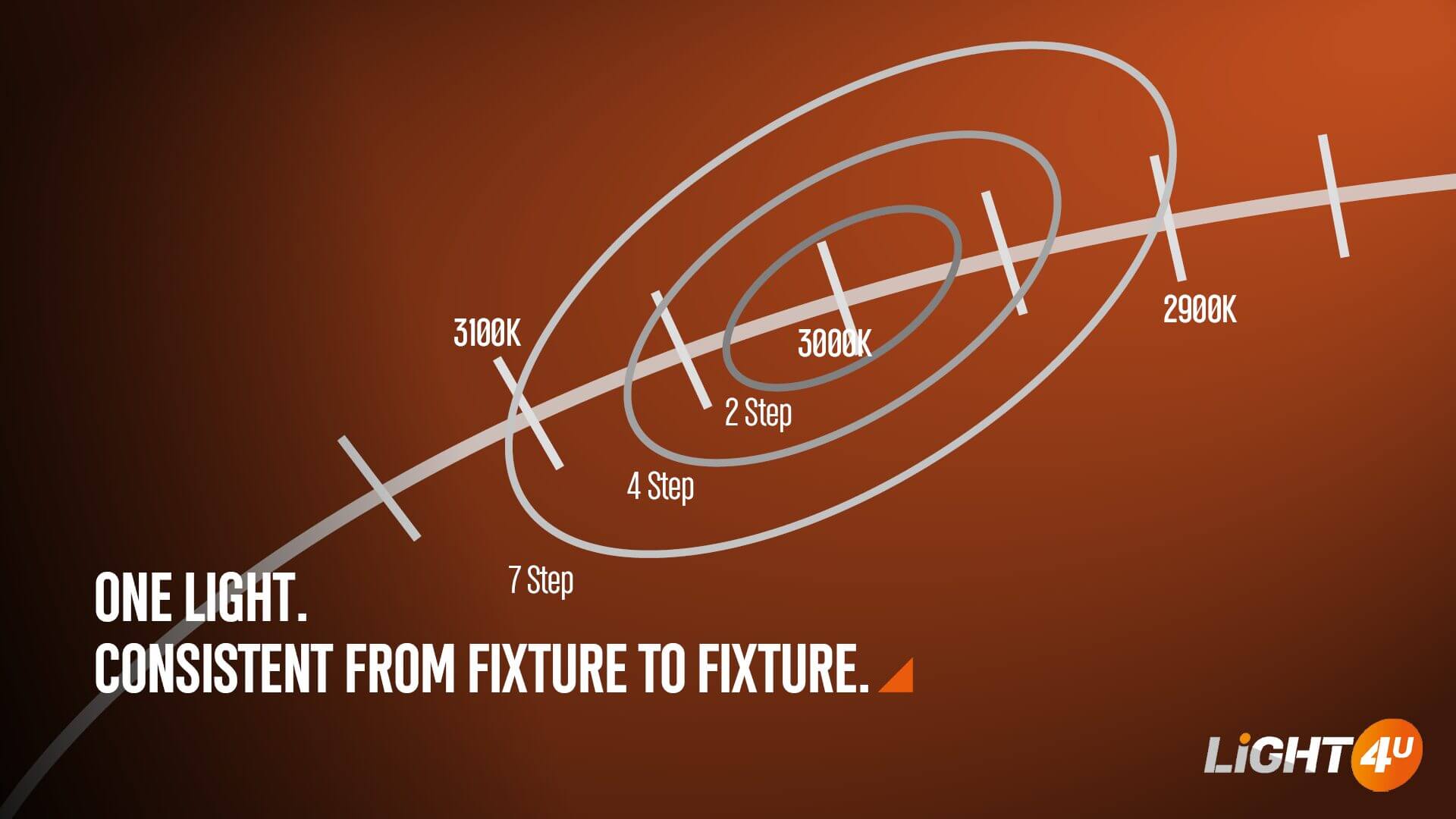
MacAdam ellipses define the amount of colour deviation from a target chromaticity point that the human eye can detect. In architectural lighting, this directly influences the visual uniformity and perceived quality of an installation.
What MacAdam ellipses describe
MacAdam ellipses are based on visual perception studies. They map tolerance areas within the CIE chromaticity diagram where colour differences are either imperceptible or only barely noticeable to the human eye.
A “step” represents the allowed distance from the defined chromaticity target. Lower step values mean tighter binning and higher colour consistency.
As a practical reference:
• 1-step: virtually no visible deviation
• 2–3-step: very tight consistency suitable for architectural projects
• 5-step: visible variation in critical installations
What happens in real installations
Colour variation becomes visible when luminaires are installed next to each other. In isolated use, deviations are rarely noticeable. In repeated layouts, they become obvious.
Critical applications include:
• Downlight grids in white ceilings
• Linear lighting systems
• Wallwashing installations
• Long corridors
• Retail environments with repeated fixtures
If 5-step LEDs are used, small shifts towards green, pink, or warmer tones may occur between luminaires. Individually, this may seem minor. Across a uniform surface, it affects perceived quality immediately.
MacAdam deviation does not influence lumen output or efficiency. It influences visual calm and professional appearance.
CCT alone is not enough
Specifying 3000K or 4000K does not guarantee uniformity. Without defining a MacAdam tolerance, luminaires may technically meet the same CCT specification yet still differ slightly in appearance.
Professional project specifications, therefore, include both:
• Defined colour temperature
• Defined MacAdam step tolerance
This combination ensures predictable visual results throughout the installation.
Light4U portfolio update: moving to 2-step MacAdam
Light4U has implemented a major quality update across the portfolio. Almost all luminaires are now supplied with 2-step MacAdam consistency.
This upgrade supports:
• Improved ceiling uniformity
• More stable wallwashing performance
• Higher perceived product quality
• Reduced visible colour deviation between batches
For offices, healthcare, retail and education projects, tighter binning supports cleaner architectural outcomes and more consistent project execution. Colour consistency is treated as a defined performance characteristic within the Light4U range.
Recommended specification level
For many commercial applications, the 3-step MacAdam is considered acceptable. However, tighter tolerances significantly improve visual quality in visible installations such as ceiling grids, linear systems, and wall washing.
With the transition to 2-step MacAdam across the Light4U range, colour consistency aligns with professional architectural standards.
MacAdam steps are not a marketing detail. They are measurable parameters that determine how consistent and professional an installation appears once completed.
Choose what is best for you.