
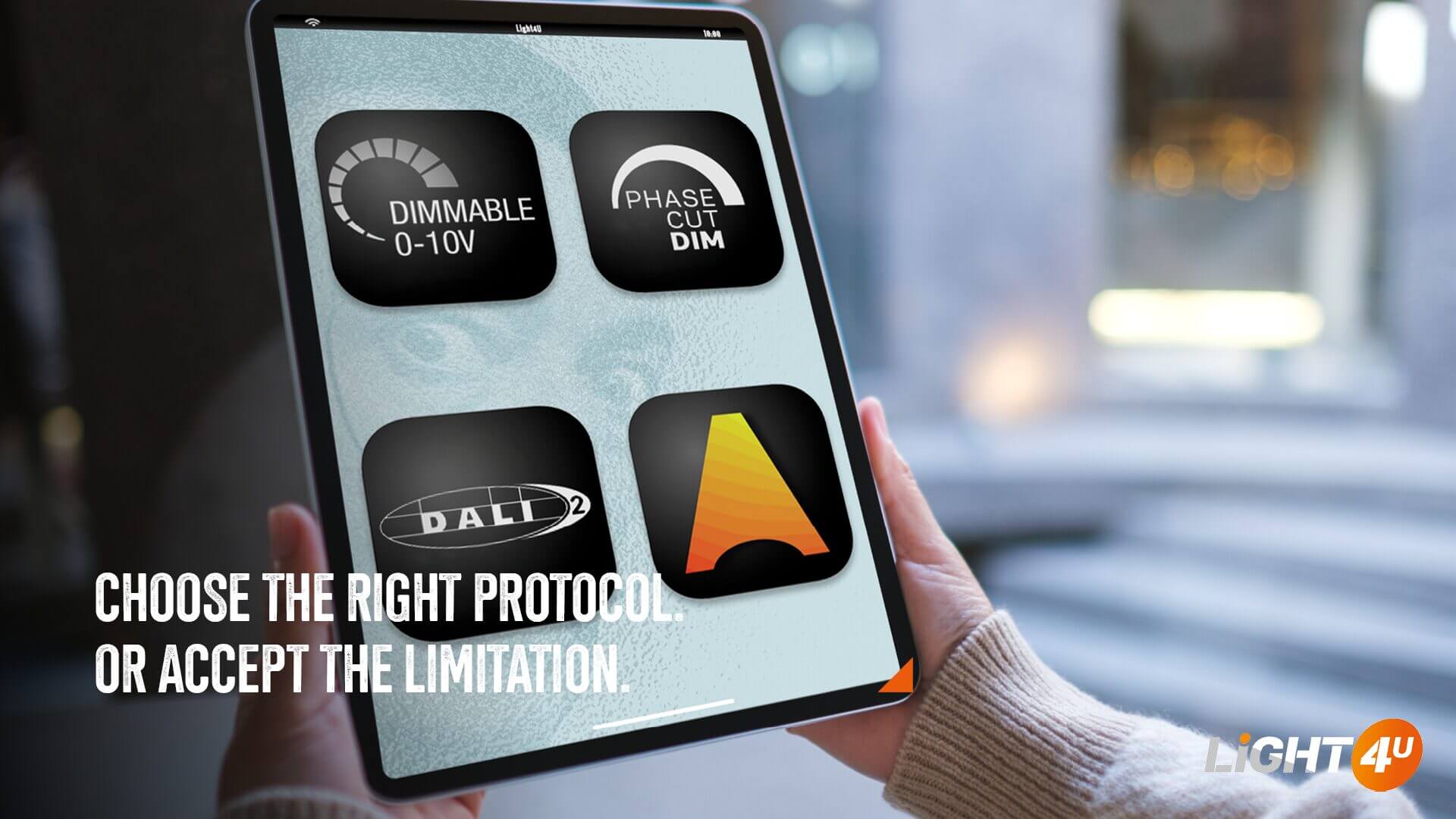
Lighting control is often presented as an upgrade.
Add dimming. Add flexibility. Add comfort.
In reality, dimming is not automatically an advantage. Poorly specified dimming creates instability, noise, compatibility issues and user frustration.
Control defines how light behaves in real conditions, not in theory.
So let’s look at the limitations without romanticising them.
Phase-Cut (TRIAC / Reverse Phase)
Phase-cut dimming reduces output by trimming portions of the AC sine wave. It was designed for incandescent lamps. LED drivers were adapted to tolerate it.
In simple terms, the system cuts pieces out of the electricity wave to reduce brightness. Old filament bulbs handled this naturally. LED electronics must constantly correct the distorted signal.
That correction is where many issues begin.
Common limitations include flicker at low levels, audible driver noise and limited dimming depth. Behaviour can also vary depending on the dimmer and driver combination, making compatibility unpredictable.
Phase-cut systems also lack communication. Luminaires cannot report their status, cannot be addressed individually and cannot participate in scene control.
The advantage is simplicity and low cost.
The limitation is that precision and scalability were never part of the concept.
1–10V and 0–10V
Analogue dimming takes a different approach. Instead of modifying the power waveform, a small control voltage tells the driver how bright it should be.
With 1–10V, commonly used in Europe, 10V means full brightness and 1V represents the minimum dim level. To switch the light completely off, mains power usually needs to be interrupted.
With 0–10V, often used in North America, 10V again represents full brightness, but 0V can represent the minimum level and sometimes allows dim-to-off depending on the driver.
Because the signal is stable, analogue dimming is technically more predictable than phase-cut.
However, the system remains fundamentally simple. All luminaires connected to the same control line respond together. Individual addressing is not possible, feedback from fixtures is absent, and scene control options are limited.
Analogue control is robust and widely used in functional spaces such as industrial halls or warehouses.
Its limitation is that it cannot create intelligent or adaptable lighting environments.
DALI
DALI (Digital Addressable Lighting Interface) moves lighting control into the digital domain.
Instead of varying voltage levels, the system sends digital commands. Each luminaire has its own address and can be controlled individually or grouped.
This enables scene setting, monitoring and integration with sensors or building management systems.
Different generations exist. DALI-1 was the original protocol, while DALI-2 improves interoperability and certification standards.
Device types define driver functionality. DT6 controls single-channel drivers, while DT8 allows multi-channel control, such as Tunable White or RGBW, within a single address.
There is also DALI Push Dim, which allows a simple push button to control DALI drivers without a full central controller.
DALI introduces structure, precision and flexibility.
Its limitations include increased infrastructure, additional wiring, and a more complex commissioning process that requires technical expertise.
Casambi
Casambi represents a different approach. Instead of wired communication, it uses Bluetooth Low Energy mesh networking.
Each luminaire becomes part of a wireless network. Control logic is managed through software rather than central hardware.
This enables flexible grouping, scene programming and fast commissioning through a mobile interface. It is particularly attractive in retail projects, renovations and spaces where new control wiring is difficult.
Casambi also offers Long Range mode, which increases communication distance and improves stability in large or high-ceiling spaces.
Wireless systems bring flexibility.
Their limitation is their dependence on network stability, correct node placement, and proper commissioning. Without careful planning, behaviour can become unpredictable.
The Hidden Limitation of “Dimmable”
Dimming is often added as a standard feature. The assumption is that it automatically improves a lighting installation.
Technically, dimming introduces additional variables. Drivers become more complex, compatibility between devices must be verified and commissioning requires greater attention.
If the application genuinely requires dynamic light levels, these efforts are justified.
If it does not, dimming simply introduces new failure points without delivering practical benefit.
Not every environment requires scenes or adjustable output.
But every environment benefits from stable and predictable light.
Conclusion
Every lighting control protocol defines boundaries.
Phase-cut offers simplicity but accepts instability.
1–10V offers reliability but accepts limited intelligence.
DALI offers flexibility but accepts higher system complexity.
Casambi offers wireless freedom but relies on a network.
There is no universal solution.
Only informed decisions.
Choose the right protocol. Or accept the limitation.