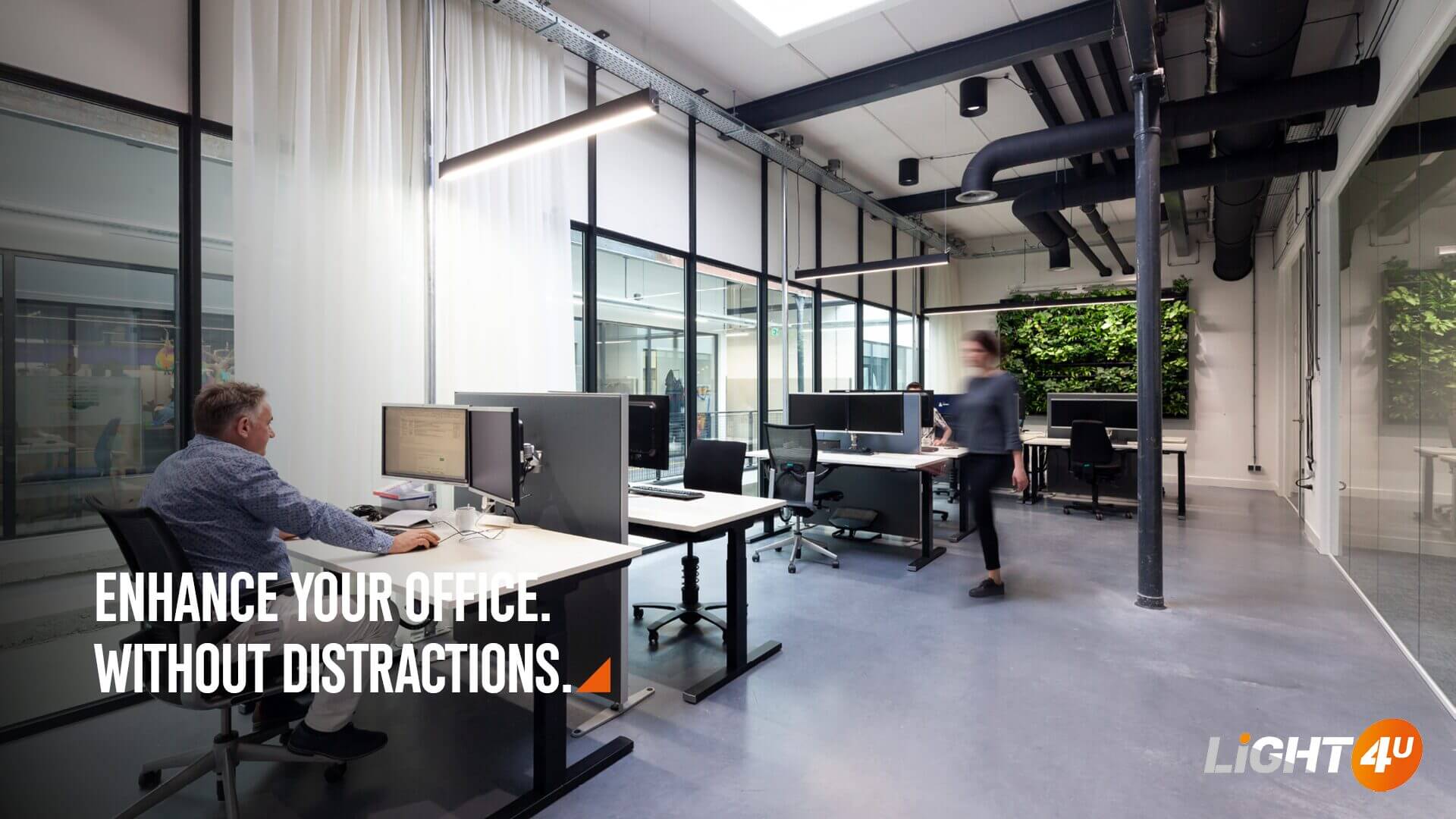
Office lighting is successful when it feels effortless. People can concentrate, screens remain comfortable to view, and the space looks clear and professional. Most office lighting concepts follow the same core principles: meeting workplace requirements, controlling glare, delivering balanced illuminance, and enabling intelligent control for adaptability.
Start with the standard, then design for people.
For typical desk work, many projects reference EN 12464-1 as a baseline. It typically targets approximately 500lx in the task area and provides strong glare control for screen work, often with UGR ≤ 19. These numbers are a foundation, not the final goal. Two offices can meet 500lx and still feel very different. The differences usually involve glare control, vertical brightness, and luminaire positioning.
UGR is the first comfort filter
UGR is often presented as a single value, but the actual result depends on the layout. Glare increases when bright luminaires are visible in the normal viewing direction, when beams are too wide for the mounting height, or when optics do not adequately shield the LEDs. A practical rule for screen-based workplaces is simple: prioritise low-UGR optics, then confirm the layout works with desk direction and ceiling height.
Balanced illuminance, not maximum brightness
A comfortable office is not “as bright as possible”. It is evenly lit with controlled contrasts. Alongside horizontal light on desks, many designers focus on vertical illumination on walls and faces. This improves perceived brightness and visual communication without pushing glare.
A robust approach is layered light:
- Ambient lighting to establish uniformity
- Vertical light to reduce contrast and improve comfort
- Local accents only where needed (reception, branding, collaboration zones)
CCT and CRI: clarity without harshness
Many office projects use neutral white light for clarity, often around 4000K. CRI targets are commonly Ra ≥ 80 as a baseline. For premium offices, CRI90 is usually preferred because materials and skin tones look more natural, and the space feels less clinical.
If the project aims for wellbeing and extended stays, tunable white becomes relevant. It allows stronger activation in the morning and a calmer atmosphere later in the day. This can be combined with simple scenes and daylight linking to improve comfort and acceptance.
Control: keep it intelligent and simple
The strongest office concepts use control to reduce energy use and increase comfort. Daylight linking, presence detection in meeting rooms, and a small set of scenes are standard best practices. Control should stay intuitive. People should not fight the system.
Translating design principles into Light4U choices
Once the parameters are clear, product selection becomes straightforward:
T-grid ceilings (modular suspended ceilings), plasterboard, or low-concrete ceilings: choose a low-UGR panel concept, such as Challenge II. Panels are efficient, provide uniformity, and integrate cleanly with standard ceiling grids.
For concrete ceilings or offices that often change layout, use a track-based approach for flexibility. Desks move, teams change, and tracks allow re-aiming without rebuilding the ceiling. A suitable option is Irmin with a louvre and low-glare optic, plus rotation for accurate positioning.
Downlight strategy (clean ceilings, focused zones): select downlights with excellent glare control and use beam angles intentionally. UGR depends on the beam choice. Narrower beams can reduce glare when positioned correctly. In the Light4U range, Donar and Cimbri (both with possible narrow beam, very low UGR or even honeycomb) can be used depending on ceiling height, spacing, and desired distribution. You can also filter luminaires from our portfolio with a UGR < 19.
Office lighting checklist at a glance
| Topic | Good target for offices | Why it matters | Light4U portfolio direction |
|---|---|---|---|
| Glare | UGR ≤ 19 for screen areas | Eye comfort and concentration | Challenge II, Irmin (louvre), Cimbri |
| Desk illuminance | Around 500lx | Task visibility without fatigue | Panels, downlights, track zoning |
| Vertical brightness | Add a wall and a face light | Perceived brightness and comfort | Track + Irmin, wallwashers, careful aiming |
| Colour quality | Ra ≥ 80 baseline, CRI90 preferred | Natural appearance and less strain | Specify CRI per project |
| CCT | Neutral white is often preferred | Clarity and attention | 4000K, tunable white where needed |
| Control | Scenes, daylight, presence | Comfort and energy | Casambi or DALI strategy, simple user logic |
If you want input on an office project, we can help translate these targets into a practical luminaire layout with the right optics, beam angles, and control logic for your ceiling type and workplace requirements. If you need any support, we are here for you!