
Colour quality is one of the most discussed topics in architectural lighting. Specifications often start with a single requirement: CRI ≥ 90. While this is a good foundation, it does not tell the full story of how light behaves in a space.
To make informed decisions, lighting designers increasingly look beyond CRI alone and consider additional metrics such as TM-30, as well as the spectral composition of the light itself. Understanding the differences between these approaches helps translate numbers into real visual experience.
What CRI measures, and where it stops
CRI, or Colour Rendering Index, measures how accurately a light source renders colours compared to a reference source of the same colour temperature. The commonly used CRI value, Ra, is calculated using a limited set of standard colour samples.
A higher CRI indicates that colours appear closer to the reference. CRI values above 90 are generally considered suitable for architectural and retail applications.
However, CRI has clear limitations. It is based on a small number of test colours, it does not describe the shape of the light spectrum, and it does not predict how natural or comfortable the light will feel over time. As a result, two luminaires with the same CRI can still look very different in practice.
TM-30; a broader view on colour rendering
TM-30 was developed to provide a more complete picture of colour rendering. Instead of a small set of colour samples, TM-30 evaluates 99 colour samples, covering a wider range of hues and saturations.
TM-30 introduces two key values. Rf (Fidelity Index) describes how closely colours match the reference, similar in intent to CRI but based on more data. Rg (Gamut Index) shows how saturated or vivid colours appear compared to the reference.
This allows designers to see whether colours are rendered neutrally, slightly enhanced, or potentially distorted. TM-30 therefore offers more insight than CRI, but it still focuses primarily on colour appearance rather than the overall quality of the spectrum.
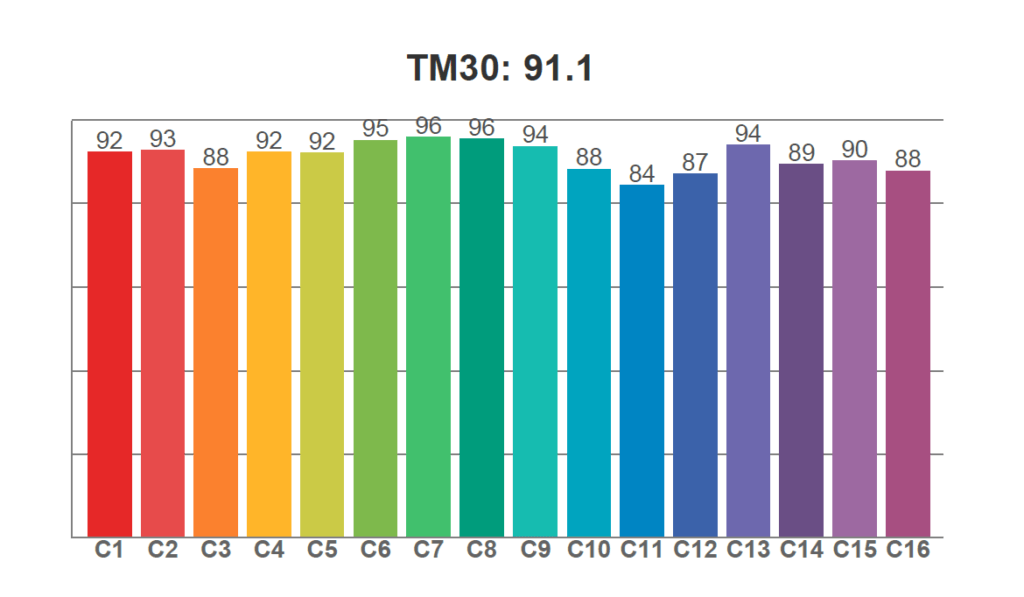
Standard CRI93
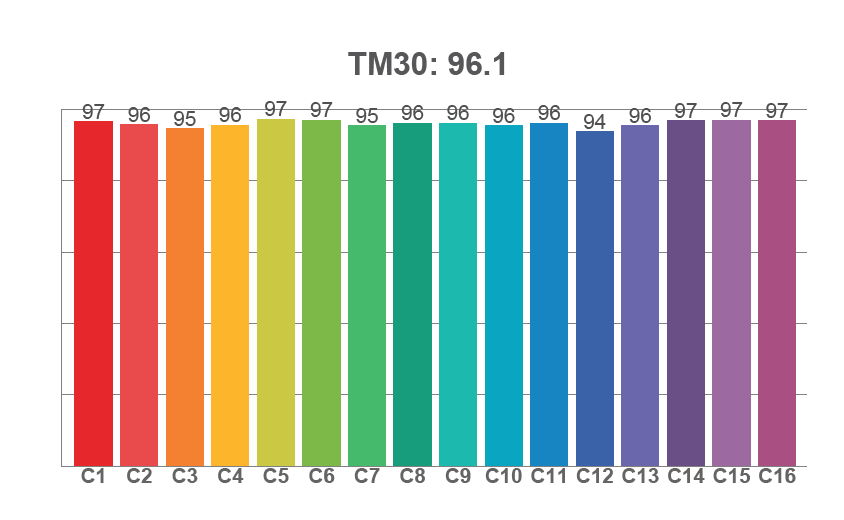
Full spectrum
Why spectrum quality matters
Beyond colour metrics, the spectral power distribution of a light source plays a key role in visual perception. A spectrum with strong peaks and gaps can render colours accurately in tests, yet still feel artificial or flat in real spaces.
A smoother, more balanced spectrum tends to improve the perception of natural materials, render skin tones more evenly, and reduce visual fatigue in environments where people spend many hours under artificial light. This is where the concept of full spectrum lighting becomes relevant.
What full spectrum means at Light4U
At Light4U, full spectrum lighting refers to LED technology engineered to deliver a balanced and continuous spectral distribution across the visible range, closer to natural daylight.
This approach goes beyond achieving high CRI or strong TM-30 values. The goal is not only accurate colours, but light that behaves naturally when interacting with materials, textures, and people.
For selected projects, Light4U applies full spectrum LED engines based on Thrive technology from Bridgelux. These LEDs are engineered to reduce strong spectral peaks and gaps, resulting in smoother and more natural light output.
CRI, TM-30 and full spectrum
CRI provides a useful baseline for colour accuracy. TM-30 expands this by describing colour fidelity and saturation across a wider range of colours. Full spectrum lighting addresses something different: the balance and continuity of the spectrum itself.
In practice, CRI and TM-30 describe how colours appear, while full spectrum describes how light feels.
When to use what
CRI remains sufficient for many functional applications. TM-30 adds value where colour nuance is important. Full spectrum lighting becomes relevant when visual comfort, natural appearance, and long exposure times are part of the design brief.
Typical applications include retail and showroom environments, hospitality interiors, museums and galleries, premium offices and meeting spaces, and healthcare or education environments.
Designing with intention
High CRI is an important starting point, but it does not define the full quality of light. TM-30 and full spectrum approaches help designers understand what happens beyond colour accuracy.
At Light4U, these metrics are used as design tools rather than marketing labels. The aim is always the same: lighting that supports comfort, clarity, and natural perception in real spaces.